Living With Schizophrenia
I recently got a question on my Q&A form regarding schizophrenia:
“How does your condition affect you on a day to day basis? Or if more appropriate week to week/month to month etc. Also, as a woman, do you feel it's affected you differently (menstruation, hormones etc)?”
The anonymous asker went on to explain that they work with people who are struggling with mental health crises, and would like to talk to someone who struggles with their mental health but hasn’t reached a crisis point to better understand how to support those in their darkest moments. I think it’s a very good question to ask, and for a very noble reason!
Explaining how schizophrenia affects me is a difficult task, because I’ve been schizophrenic for a long time. Schizophrenia is normally diagnosed in your early 20s, but it can appear much younger. I’ve always had an unusually vivid imagination, but if I had to pinpoint a moment when I ‘became schizophrenic’, it would be when I was fourteen and wholeheartedly believed that there were Chinese spies planting cameras and listening devices in my bedroom. That was my first major break from reality that I’m aware of, and happened over a decade ago now. At the time, it was diagnosed as bipolar mania and poor quality of sleep due to my age and extenuating circumstances (I was, to be fair, sleeping very poorly).
Since then, I’ve been coping with antidepressants and therapy, as many mood stabilizers that help with schizophrenia also lower my already chronically low blood pressure. I am extremely fortunate, seeing as I have a stable support system, a partner I can trust, and family members I’m close to who also cope with schizophrenia. Many schizophrenics and others with psychosis disorders don’t have that luxury, and don’t realize anything is wrong until they have reached that point of crisis.
For schizophrenia and psychosis in particular, I recommend first reading or listening to Malady of the Mind by Jeffery Lieberman. Schizophrenia has a turbulent treatment history, the echoes of which still carry into modern-day psychiatric facilities and public view. It’s a terrifying diagnosis to receive, in part because of how it’s been portrayed in pop culture and how it’s been treated in the recent past. Because of this, many schizophrenics and others struggling with psychosis will avoid talking about their experience or receiving a diagnosis because they fear social backlash, isolation, and involuntary institutionalization.
By advocating for myself and my experiences often, I hope to help chip away at that trend and make talking about psychosis disorders less taboo. So, with all that exposition out of the way, let’s get into how I experience schizophrenia, shall we?
Schizophrenia is a blanket term for a large number of symptoms, similar to the way ADHD and Autism are experienced differently by everyone under those diagnoses. For me specifically, I experience disorganized movement, disorganized thoughts, and auditory hallucinations on a daily basis. I’ll also experience periodic bouts of paranoid delusions. Saying that is all well and good, but what does that actually mean?
Let’s start with the easiest to explain: disorganized movement.
Disorganized movement falls into two unofficial categories- voluntary and involuntary. Voluntary movements are things your body wants to do, but you can generally suppress with enough focus. Involuntary movements are things your body does without your input, and are more difficult to mask.
In me, disorganized voluntary movement expresses itself with pacing, bouncing my legs, and shaking/wringing my hands.
As a teenager, I used to go into the back yard of my house and pace until I wore a groove into the grass where my usual path was. I’ve also always flapped or shaken my hands. People used to comment on it when I was a child, asking my parents in front of me if I was okay.
As an adult, I suppress the movement even around my fiance, which results in me shaking my hands later to the point I sometimes hurt my wrists. I’m working on being less ashamed of these odd behaviors, but they’re still not something I feel like I can often discuss with others. Even during livestreams, I will get up from my desk with the excuse that I am “stretching,” when really I’m just pacing around my office letting myself shake out my hands.
As far as disorganized involuntary movements go, these are more socially disruptive. I make odd facial expressions sometimes, or conversely, fail to make the correct expression in connection with the emotion I’m feeling. People have been disturbed by me not smiling when I laugh, or grimacing at a statement I found interesting, or just making an odd face in general while focusing.
This is part of the reason I don’t have a consistent face cam on streams. The one time I tried it, I went through the VOD and was embarrassed by the weird expressions I would make when I forgot to consciously emote.
I also experience something informally called a protective shutdown. This is when I am suddenly overwhelmed by untargeted, often irrational stress, and I simply… switch off. I go completely still, and my thoughts race. I appear catatonic in these moments, and while I can see and hear what’s going on around me, I cannot feel touch and I do not process anything until later.
These episodes can last up to an hour, though they are thankfully getting more rare as I work with my support system to better handle stress. I have a command in my chat, “!freeze,” that those familiar with me can use when I suddenly stop moving or responding mid-stream, and I normally warn the community when the episodes have picked up again. These freezes make it very difficult to hold a regular job.
Next, let’s talk about disorganized thoughts. This is the symptom that, to me, is the most disruptive. Let’s take an example task, such as, “Do the dishes.” A neurotypical thought process would, to my understanding, look something like this:
I need to do the dishes. > I need to turn on the faucet. > I need to pick up the sponge. > I need to put soap on the sponge.
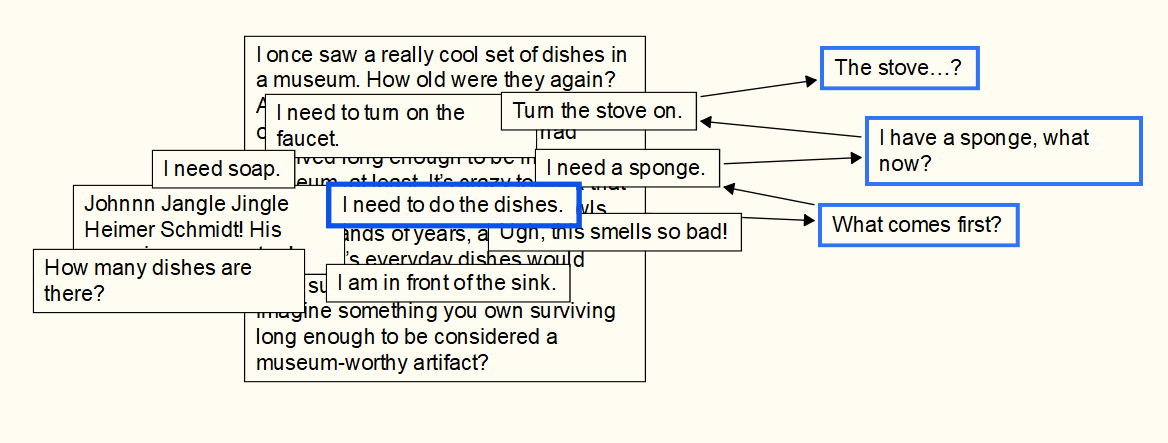
A disorganized thought process is far less linear. Consider the thought process below, with the blue highlighted boxes being the “active” thought at the forefront of the mind.
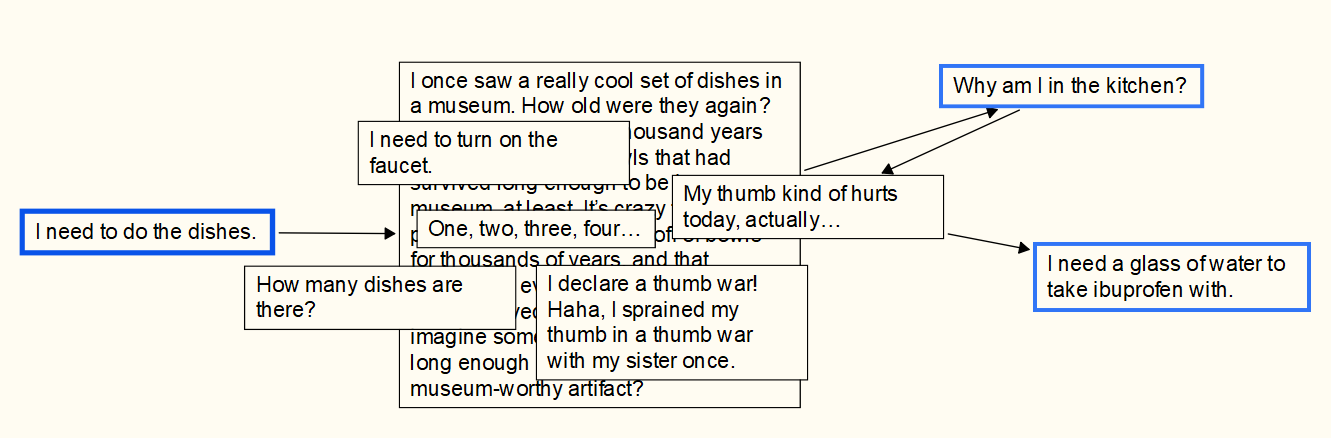
As you can see, the thought process is far less linear, with multiple lines of vaguely connected thoughts overlapping and causing me to completely lose focus. Disorganized thinking can also look like this:
At this point, something entirely unrelated has filtered into the pile of thoughts, and inserted itself into the process I’m trying to complete. Being this disorganized can be dangerous, so when my mental state feels like this, I tend to avoid any task that feels overly daunting. Even then, I’ll find myself doing something- bathing, getting dressed, grabbing a quick meal -and doing things completely out of order, or adding steps that don’t make any sense.
The thing is, these thoughts make sense to me. In the moment, I don’t realize that I’m confused. It’s only after the fact that I realize that I’ve done something wrong, which can make tasks like cooking dangerous when I’m unsupervised and struggling with severely disorganized thinking.
Ironically, this method of thinking makes it very difficult to write. This is why I go through so many outlining phases, to keep myself on track. Seeing loose connections, however, prompts me to be a worldbuilder, as I then go on to explain how those loose connections impact one another and fill in the gaps.
Now let’s talk about the elephant in the room. No, I do not hear voices telling me to enact violence against others or myself. When I hear voices, it’s normally brief snippets of conversation with someone I know, or murmuring in another room. More often than voices, I hear footsteps, knocking at the door, or ticking sounds. Occasionally I’ll hear a music box that I used to sleep with as a child.
Most schizophrenics do not hear voices telling them to harm others. Those that hear voices at all either hear nondescript, familiar voices in conversation, or they hear voices that reflect their internal anxieties and thoughts. This does sometimes manifest as voices telling them to hurt themselves, but that nearly always occurs in tandem with severe depression and self-loathing.
I always say that paranoid hallucinations and delusions work on Ghostbuster rules- you subconsciously choose the form of the destroyer. If you’ve been thinking about something a lot, chances are, your hallucinations (and your delusions, for that matter) will start to revolve around it.
This is why I have to play Balatro with the music off a lot of the time. I refer to my auditory hallucinations as a whole as the “peanut gallery,” and they love that damn soundtrack!
Hearing voices outside of yourself is not normal, even if you can recognize retroactively that they are not real. This is something that had to be explained to me in adulthood by a psychiatrist, who was rightfully concerned I had been misdiagnosed. If you hear voices that you do not identify as yourself, please seek psychiatric help. There are a number of conditions, both mental and physical, that can cause auditory hallucinations, and nearly all of them benefit from early treatment. Receiving treatment and a diagnosis can be a long, painful, exhausting process, but it is worth it. So please, seek out assistance if you can.
In addition to the daily symptoms, I also experience paranoid delusions. The most common one is that someone is watching me through my phone and webcam, and monitoring my activity. Another delusion I’ve had is that there is an intruder in my home, keeping themselves just out of sight, who has malicious intentions and will hurt me if I acknowledge them. Delusions can last anywhere from a few hours to a few days, and very rarely can be reasoned with.
However, there’s an interesting phenomenon in paranoid delusions, where I am aware that if I say anything about them, no one will believe me. This suggests to me that there’s a part of myself that isn’t fully convinced. Battling a paranoid delusion is extremely difficult, because the brain becomes convinced of something beyond all evidence. Someone I know recently said something that I think describes the situation perfectly: You cannot logically reason against an idea that is not rooted in logic.
When I am delusional, my fiance and I (at this point) mostly just have to wait for the delusions to pass. When I think I’m being watched, I keep my phone camera and webcam covered and pointed away from me. When I think there’s someone in the apartment, my fiance helps me keep vigil, or we leave the apartment for a few days (though this is thankfully an extremely rare delusion). If a delusion were to become extreme to the point of causing true panic, or were to last more than a few days, I would need to go to the hospital. I have full confidence in my fiance to make this judgment call when I am impaired by my condition.
In Tennessee, there is a set of laws called the Baker Act, which allows concerned loved ones to involuntarily admit people suffering from psychosis to a hospital psychiatric ward. If my fiance and I were to move out of Tennessee, we would not do so without first taking extra steps to legally make my fiance my medical power of attorney. This will be legally implied when we are married, but I will still probably take the extra steps to put it explicitly in writing, just in case.
Another part of this asker’s question is whether or not I feel like I’ve been impacted differently because I am biologically female. To which I would say… yes and no.
It was much harder to get a schizophrenia diagnosis because I am female. A lot of my paranoia was blamed on hormonal issues, puberty, and menstruation. Women are also considered more dramatic about their symptoms than men, so I wasn’t taken seriously by several medical professionals.
As far as whether or not my symptoms impact me differently, though, I can’t say for certain. The only person I have to compare my symptoms to is my uncle, who is also schizophrenic. From our conversations, his symptoms seem to come and go in similar waves as mine. I can’t say that I’ve ever felt excessively “hormonal” or that being in certain areas of my hormonal cycle aggravated my symptoms any more than any other stressor would. My menstrual cycle does impact my schizophrenia, as I have very stressful periods, but again, I’m not sure this would be different if I were a man.
Any stress on the body and mind can worsen schizophrenia, depending on the person. While males have a different hormone balance, they also go through different phases of life that add stress to their body and mind. Additionally, while males do not have a menstrual cycle, they do experience a daily hormone cycle that research suggests may be more dramatic than the female daily hormone cycle.
So, to summarize, I feel that my feminine presentation and my social experiences as a woman have contributed in shaping my path in diagnosis, and possibly the way my schizophrenia presents. However, those things seem to me to be part of a greater tapestry of how my entire life has impacted my experience with schizophrenia. I’d have to do more research to know whether or not there is a significant difference between schizophrenia in females and males, and I’d strongly encourage anyone reading this to do further research as well.
There you have it, then. That is how I would describe my experience with schizophrenia. There’s a lot more I could say and go into, but I think this is the best attempt I’ve taken at articulating an answer to this question so far. If you find yourself relating to this article and wondering if you could benefit from psychiatric help, I recommend speaking with a psychiatrist about your concerns. Also, again, I strongly recommend reading Malady of the Mind to learn more about the treatment history of schizophrenia.
Have a question you'd like to ask me, about schizophrenia, writing, or just in general? Check out my Q&A Form! Ask Me Anything
0 Comments Add a Comment?